Academic Project
Skin Lesion Segmentation
Academic computer-vision work focused on skin-lesion segmentation and model evaluation.
Problem
Medical image research needs carefully framed segmentation experiments before any diagnosis-oriented use can be discussed.
Scope
Academic reviewers and machine-learning learners evaluating segmentation workflows.
My contribution
Built an academic computer-vision workflow around lesion segmentation, training, and validation analysis.
- Built a segmentation workflow for lesion image experiments.
- Compared predicted masks with reference-mask style outputs in an academic evaluation flow.
- Documented the work as model experimentation rather than a diagnostic system.
Technical decision
Presented the project strictly as academic model-training work and avoided clinical deployment claims.
Architecture and data flow
Built an academic computer-vision workflow around lesion segmentation, training, and validation analysis.
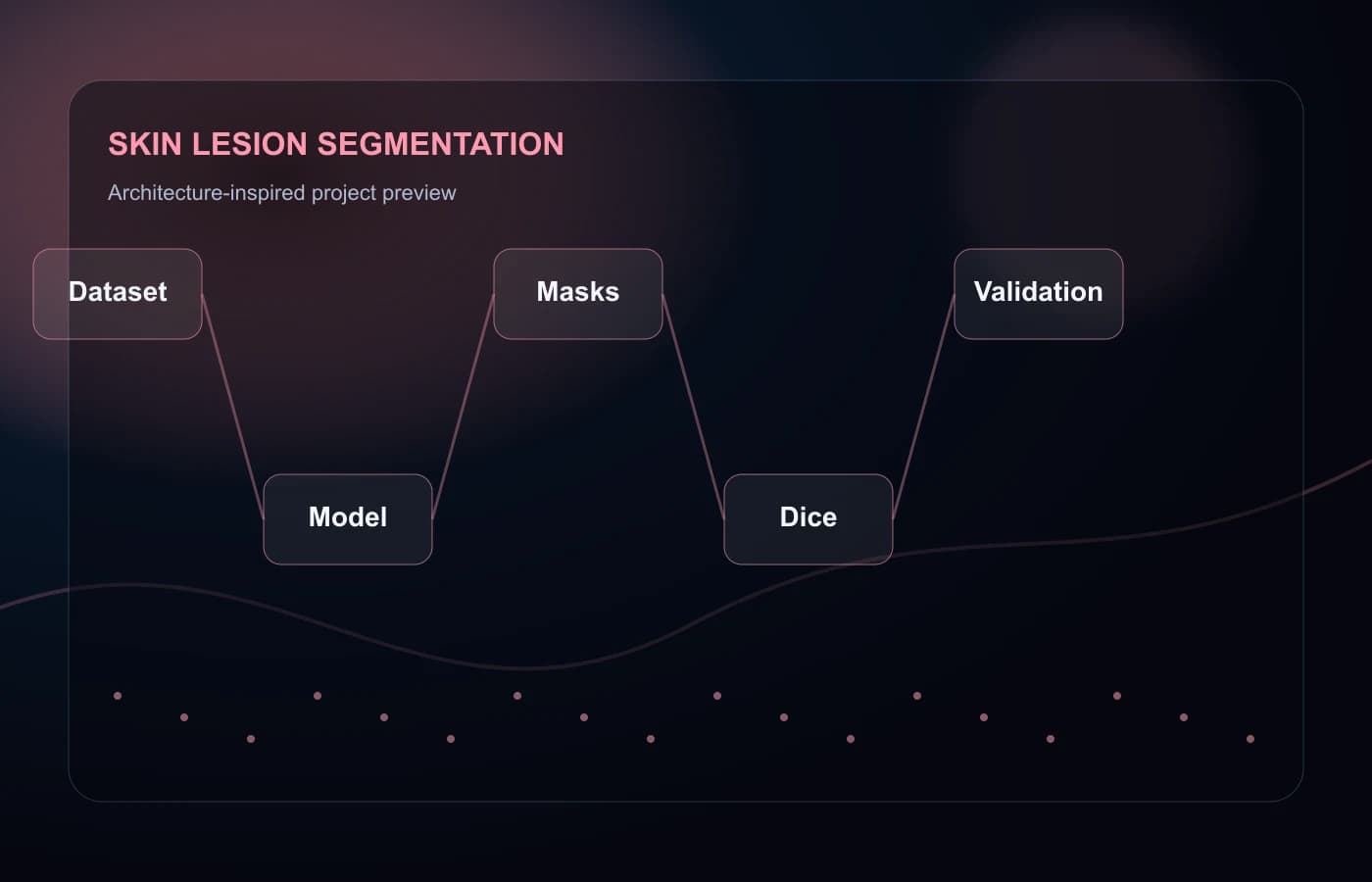
Python training pipeline with dataset preparation, segmentation model training, mask comparison, and metric review.
Images move through preprocessing, model inference, mask comparison, and metric review in a controlled academic workflow.
No patient data or clinical production workflow is represented in the public portfolio.
Technical challenges
- Avoiding diagnostic claims from academic segmentation work.
- Explaining segmentation visually without inventing unsupported metrics.
- Keeping dataset and model limitations clear.
Outcome
Academic model-training work; no clinical deployment or diagnostic claim is implied.
Limitations
Clinical validation, dataset licensing review, and healthcare deployment are outside the verified scope.
Future improvements
Add reproducible notebooks, verified metrics, and clearer dataset documentation when available.